Description
- CD98, also known as 4F2, is a widely expressed disulfide-linked heterodimer in the solute transporter family. It consists of an 85 kDa glycosylated type II transmembrane heavy chain and a 40‑50 kDa non-glycosylated light chain with 12 transmembrane segments. It is expressed on T, B, NK cells, granulocytes and many cell lines. The multifunctional protein CD98 heavy chain (CD98HC, Slc3a2) associates with integrin b1 through its cytoplasmic and transmembrane domains and the CD98HC-mediated integrin signaling is required for maintenance of ES cell proliferation.
- CD98hc is significantly abundant in the capillaries and microvessels of the mouse brain, localizing to both the luminal and abluminal surfaces of brain endothelial cells. It heterodimerizes with one of six CD98 light chains to form amino acid transporters that can transport a total of 15 different amino acids across the blood-brain barrier (BBB), including both small and large neutral amino acids, as well as cationic amino acids.
- The exons 2-10 of rat Cd98 gene that encode the extracellular domain were replaced by human CD98 exons 4-12 in B-hCD98HC rats.
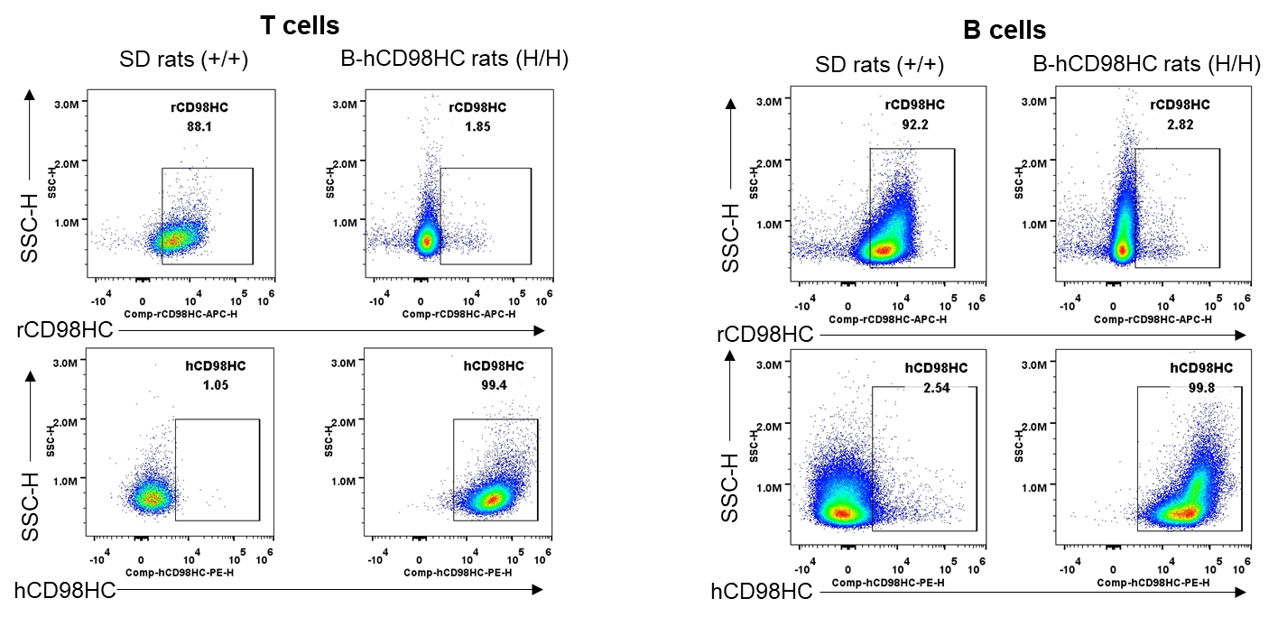
- Human CD98HC was exclusively detectable on T cells and B cells in homozygous B-hCD98HC rats.
- This product is used for tumor pharmacology and safety evalsuation of anti-CD98HC antibody, as well as assessing the potential of the drug to penetrate the blood-brain barrier.
Targeting strategy
Gene targeting strategy for B-hCD98HC rats. The exons 2-10 of rat Cd98 gene that encode the extracellular domain were replaced by human CD98 exons 4-12 in B-hCD98HC rats.
Human CD98HC mRNA Expression
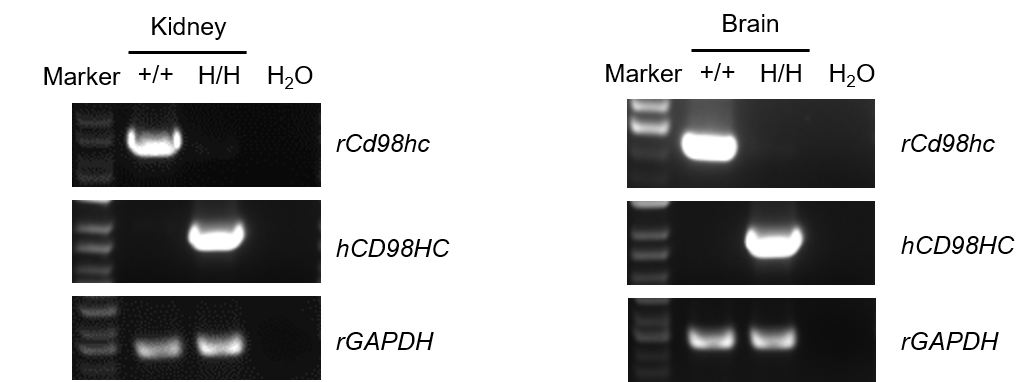
- Mouse Cd98hc mRNA is detectable only in wild-type SD rats.
- Human CD98HC mRNA is detectable only in homozygous B-hCD98HC rats, but not in wild-type SD rats.
Species specific CD98HC gene expression in wild-type SD rats and homozygous humanized B-hCD98HC rats by RT-PCR. Kidney and brain were collected from wild-type SD rats (+/+) and homozygous B-hCD98HC rats (H/H), then cDNA libraries were synthesized by reverse transcription, followed by PCR with rat or human CD98HC primers.
Human CD98HC Protein Expression in Spleen
- Mouse CD98hc is detectable only in wild-type SD rats.
- Human CD98HC is exclusively detectable in homozygous B-hCD98HC rats, but not in wild-type SD rats.
Strain specific CD98HC expression analysis in wild-type SD rats and homozygous humanized B-hCD98HC rats. Splenocytes were collected from wild-type SD rats (+/+) and homozygous B-hCD98HC rats (H/H) (female, 7-week-old, n=1). Protein expression was analyzed with anti-mouse CD98HC antibody (Biolegend, 128211) and anti-human CD98HC antibody (Biolegend, 315603) by flow cytometry.
Human CD98HC Protein Expression Across Tissues
- Human CD98 is detected in the liver, spleen, lung, kidney, spinal cord, cortex, hippocampus, cerebellum, midbrain, thalamus and striatum of homozygous B-hCD98HC rats, and is absent in wild-type rats.
Western blot analysis of hCD98HC protein expression in homozygous B-hCD98HC rats. Various tissue lysates were collected from wild-type SD and homozygous B-hCD98HC rats (H/H), and then analyzed by western blot with species-specific anti-human CD98 antibody (Abcam, ab307587). 40 μg total proteins were loaded for western blotting analysis. Human CD98 is detected in the liver, spleen, lung, kidney, spinal cord, cortex, hippocampus, cerebellum, midbrain, thalamus and striatum of homozygous B-hCD98HC rats, and is absent in wild-type rats.
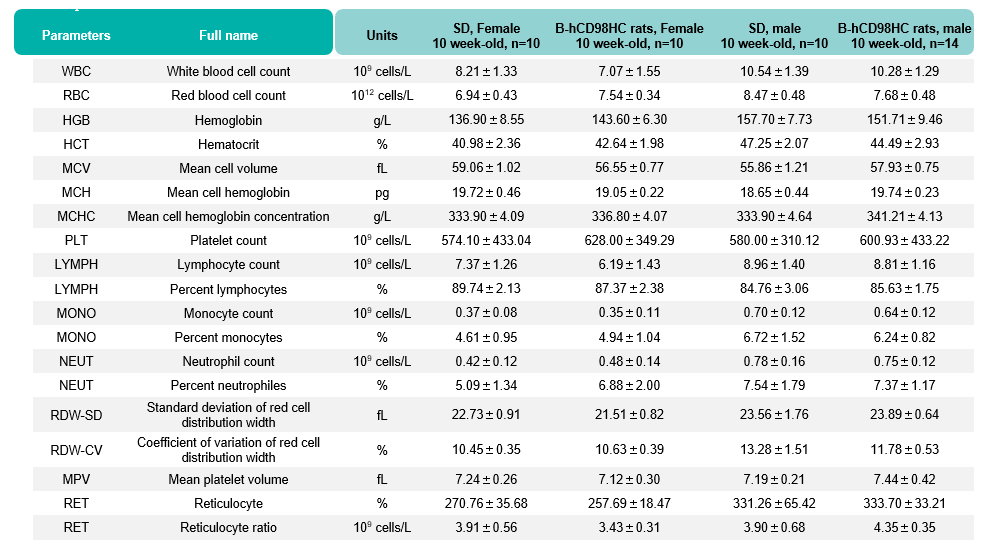
Hematology Analysis
- Humanization of CD98HC does not alter hematological
Values are expressed as mean ± SD.
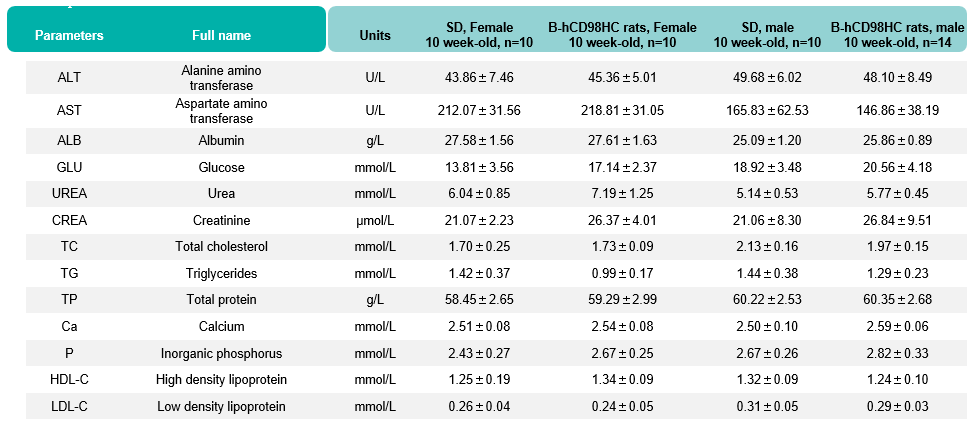
Biochemistry Analysis
- Humanization of CD98HC does not alter various blood biochemical
Values are expressed as mean ± SD.
* When publishing results obtained using this animal model, please acknowledge the source as follows: The animal model [B-hCD98HC rats] (Cat# 113123) was purchased from Biocytogen.